


Colorado's 2026 drought means every watering day matters.
The goal isn't simply to put more water on your lawn.
It's to help the water you're already allowed to use reach the soil and root zone instead of disappearing through runoff, overspray, evaporation, or poor infiltration.
Make Every Drop Work Harder.
Residential lawn water-efficiency treatments available in Lakewood and surrounding areas.
2026 Drought Update
Lakewood-Area Homeowners Are Facing a Very Different Watering Season
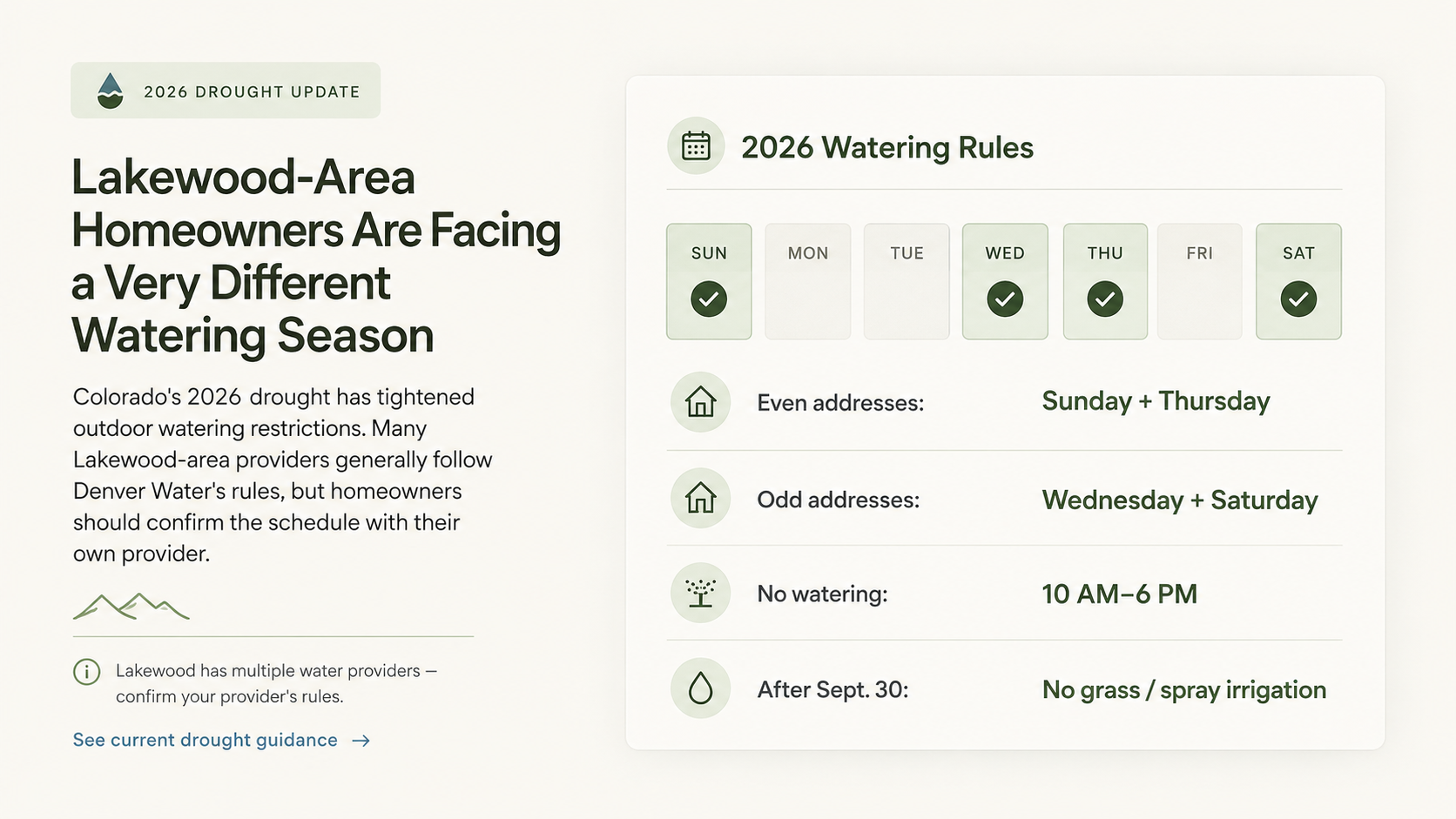
Colorado's 2026 drought has resulted in significantly tighter outdoor water restrictions.
For Denver Water customers, lawn watering is currently limited to two assigned days per week through September 30, 2026.
Current Denver Water residential schedule:
Even-numbered addresses:
Sunday and Thursday
Odd-numbered addresses:
Wednesday and Saturday
Lawn watering is not permitted between 10 a.m. and 6 p.m.
Beginning October 1, Denver Water is prohibiting grass watering and spray irrigation unless a specific exception applies.
What About Lakewood?
Lakewood is served by multiple water providers. Many purchase water from Denver Water and generally follow Denver Water's rules, but restrictions can vary by provider.
Always verify your specific watering schedule with your water provider before irrigating.
The important takeaway is the same:
We have less water to work with.
So the question becomes:
How do we get more benefit from the water we are already using?
MORE WATER ISN'T ALWAYS THE ANSWER
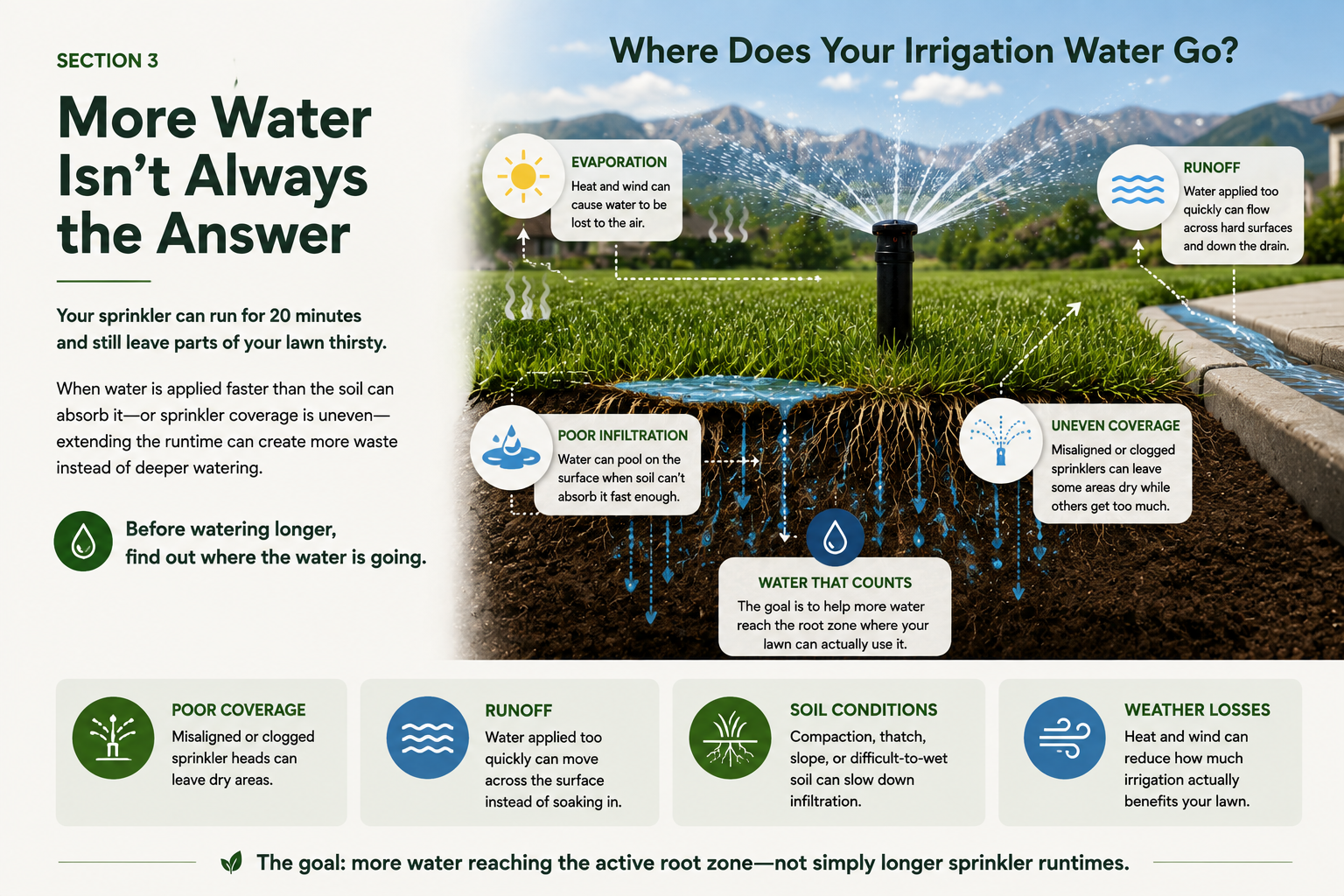
Your Sprinkler Can Run Without Your Lawn Getting the Full Benefit
Have you ever watched sprinklers running while water travels down the sidewalk or into the gutter?
That's water you paid for.
It also isn't helping your lawn.
Colorado lawns can struggle with:
Heavy or compacted soils
Sloped areas
Thatch
Poor sprinkler coverage
Hydrophobic or difficult-to-wet areas
Water being applied faster than the soil can absorb it
Hot, windy conditions
Uneven irrigation
When water can't enter the soil efficiently, simply extending the sprinkler runtime can create more runoff rather than deeper watering.
The better strategy is to examine how the water is being applied and how well it is penetrating the soil.
CHECK WHERE YOUR WATER IS ACTUALLY GOING
WHAT ARE YOU LOOKING FOR?
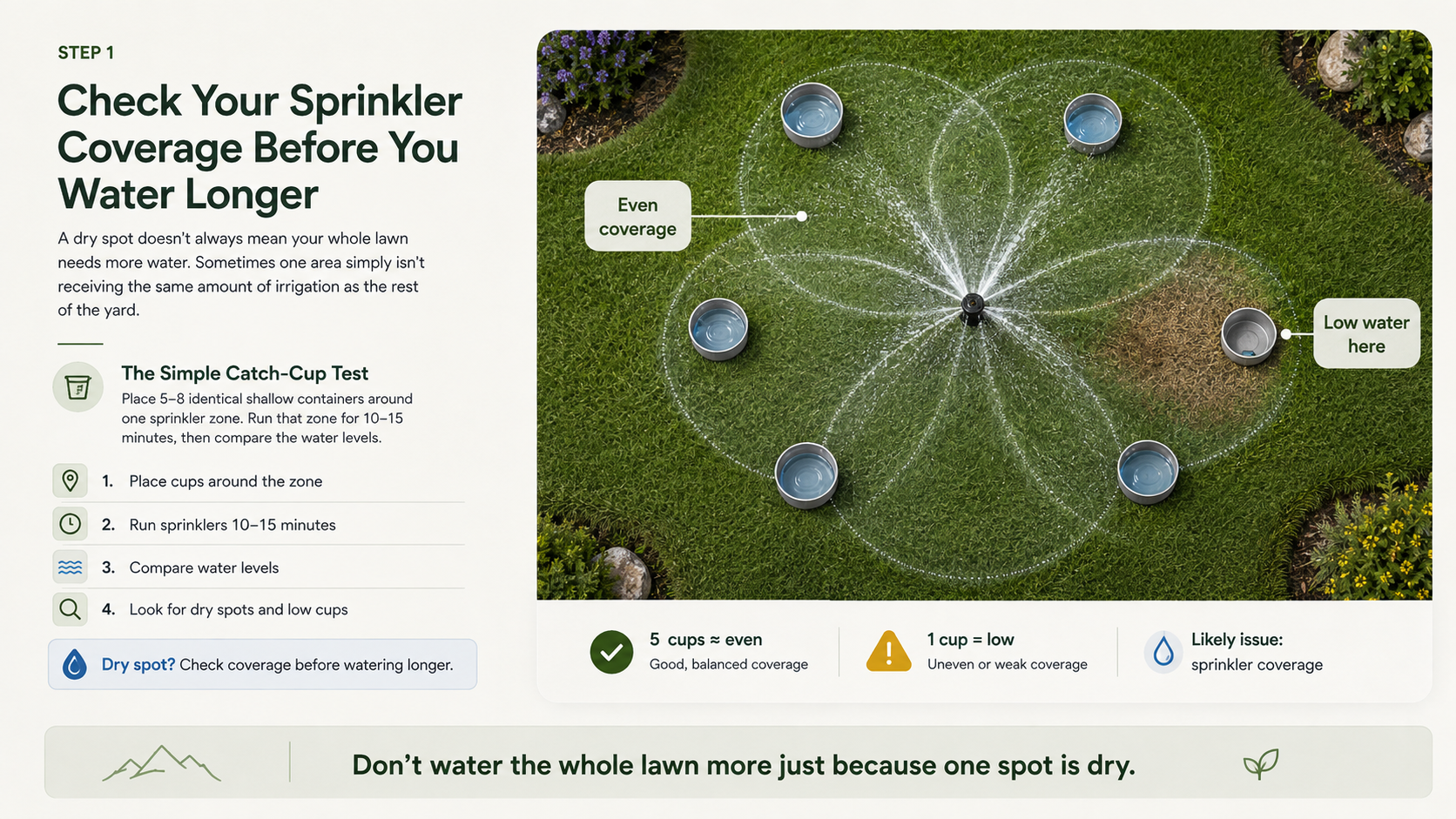
EVEN WATER LEVELS
If the containers contain roughly similar amounts of water, your coverage is probably reasonably uniform.
ONE OR TWO LOW CONTAINERS
The dry area may have a coverage problem rather than a watering-duration problem.
Check for:
Misaligned sprinkler heads
Clogged nozzles
Damaged heads
Obstructions
Low pressure
Poor sprinkler overlap
WATER IN SOME CANS — NOTHING IN OTHERS
You may have a significant irrigation-layout or equipment problem.
Running the whole zone longer could simply overwater the areas already receiving enough.
WHY THIS MATTERS
Don't Water 100% of Your Lawn More Because 10% Looks Dry
Suppose most of your lawn receives enough irrigation after 15 minutes, but one corner receives only half as much water.
Increasing the entire zone from 15 minutes to 25 minutes may not solve the real problem.
Instead, you could:
Overwater most of the lawn
while still leaving the poorly covered area relatively dry.
The better solution may be as simple as adjusting or repairing a sprinkler head.
QUICK VISUAL CALLOUT
DRY SPOT?
Before adding more watering time, check:
1. COVERAGE
Is water actually reaching the area?
2. EQUIPMENT
Are sprinkler heads working correctly?
3. RUNOFF
Is water leaving the lawn before it can soak in?
4. INFILTRATION
Is the soil accepting the water that's being applied?
KEY TAKEAWAY
Measure First. Adjust Second. Water Longer Only When Necessary.
A small amount of troubleshooting can reduce wasted water and help you make much better use of your limited watering days.
Once you know the water is being distributed evenly, the next question is:
Is the soil absorbing it fast enough?
NEXT:
Cycle and Soak — A Better Way to Water Colorado Lawns
STEP 1:
Check Your Sprinkler Coverage Before You Water Longer
A brown or dry patch doesn't automatically mean your entire lawn needs more water.
Sometimes one area simply isn't receiving the same amount of irrigation as the rest of the yard.
Before increasing your sprinkler runtime, take a few minutes to find out where the water is actually landing.
THE SIMPLE CATCH-CUP TEST
You can check sprinkler coverage with items you probably already have at home.
Place 5–8 identical shallow containers around one sprinkler zone.
Tuna cans, cat-food cans, or identical plastic containers work well.
Position them in different areas:
Near sprinkler heads
Between sprinkler heads
Near the edges of the zone
In any area that regularly looks dry
In an area that normally looks healthy
Then run that sprinkler zone for approximately:
10–15 Minutes
When the cycle is finished, compare the amount of water collected in each container.
Use “Cycle and Soak” Instead of One Long Watering Cycle
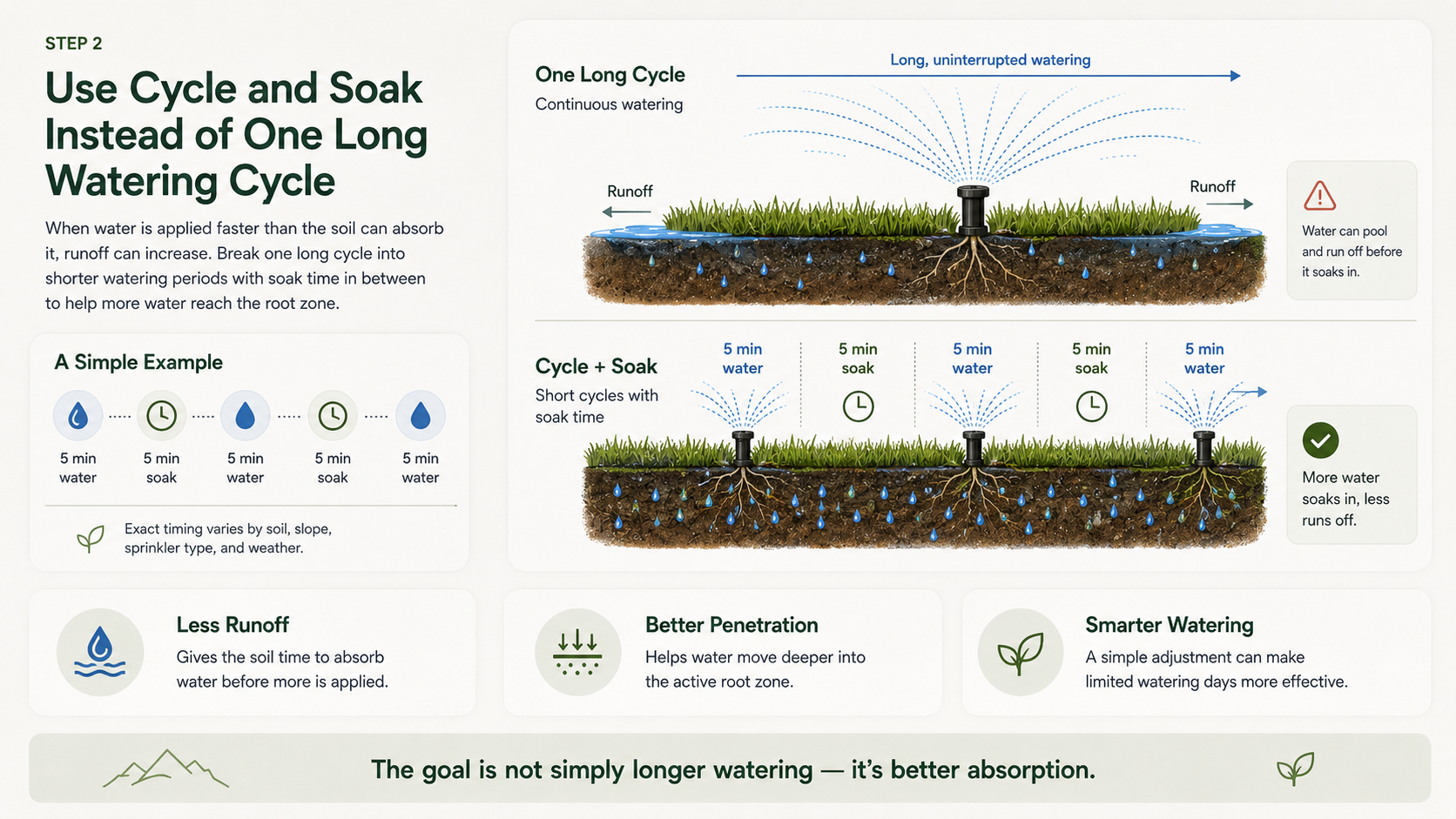
One of the simplest ways to reduce runoff is to divide your watering into shorter cycles.
STEP 2
Instead of running a sprinkler zone continuously, water for a shorter period, give the soil time to absorb the water, and then run the zone again.
For example:
Instead of:
15 minutes continuously
Try:
5 minutes watering
5 minutes soaking
5 minutes watering
5 minutes soaking
5 minutes watering
The exact timing will vary depending on your lawn, soil, sprinkler heads, slope, weather, and irrigation system.
The principle is simple:
Give the soil time to absorb the water before applying more.
This can be particularly useful on Colorado lawns with clay-heavy soils, slopes, compaction, or areas prone to runoff.
Water When Evaporation Is Lowest
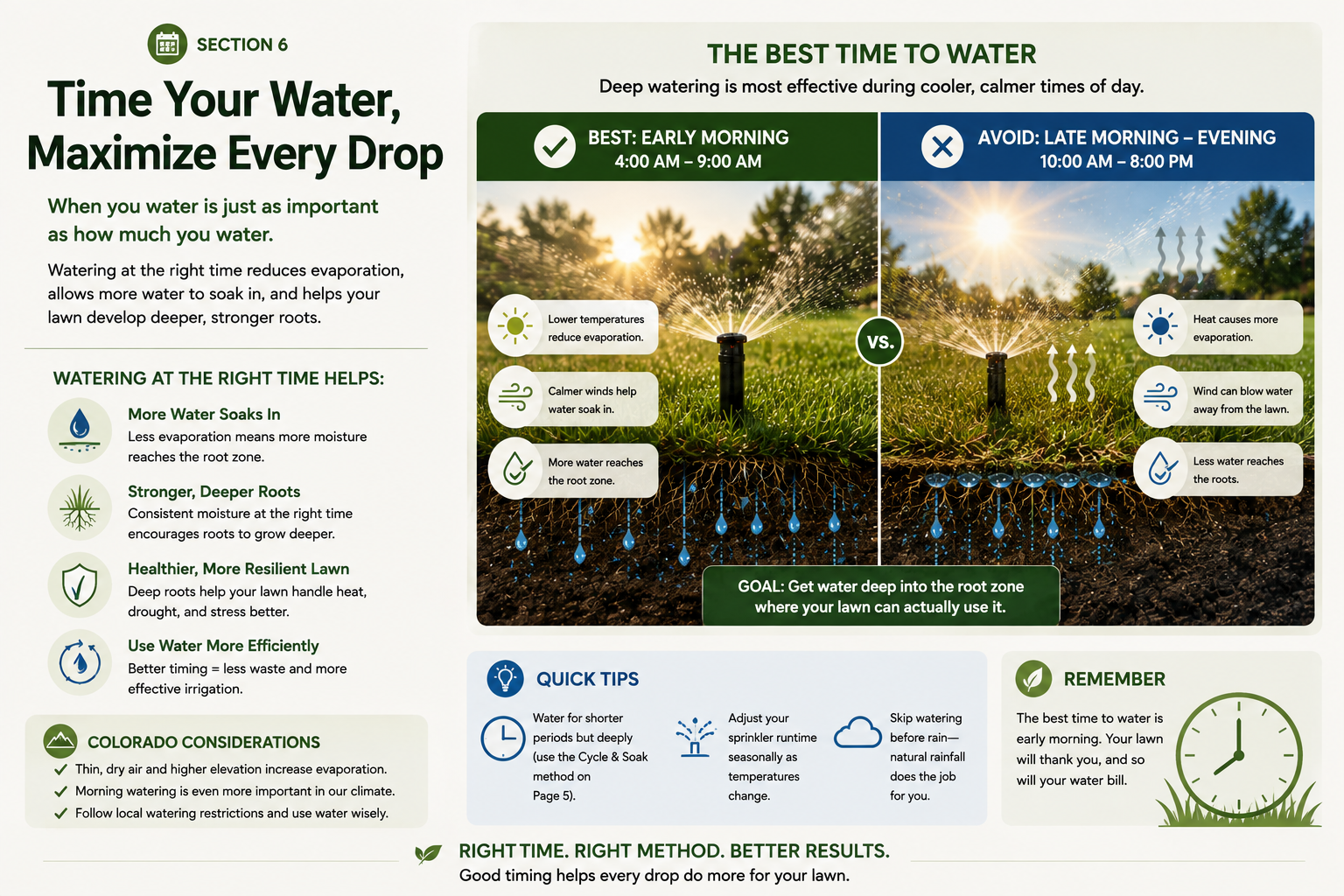
STEP THREE
During hot Colorado summer days, some irrigation water can be lost before it ever benefits your grass.
Water during the cooler parts of the day.
For Denver Water customers, watering is currently prohibited between:
10:00 a.m. and 6:00 p.m.
Early morning watering can work especially well because temperatures are cooler and winds are often lighter.
Avoid watering during:
High winds
Rain
The hottest portion of the day
And don't irrigate simply because the sprinkler controller says it's time.
Let the lawn help tell you when it needs water.
Signs of turf stress can include a grayish or bluish appearance or footprints that remain visible after walking across the lawn.
Mow Smart Keep More Moisture
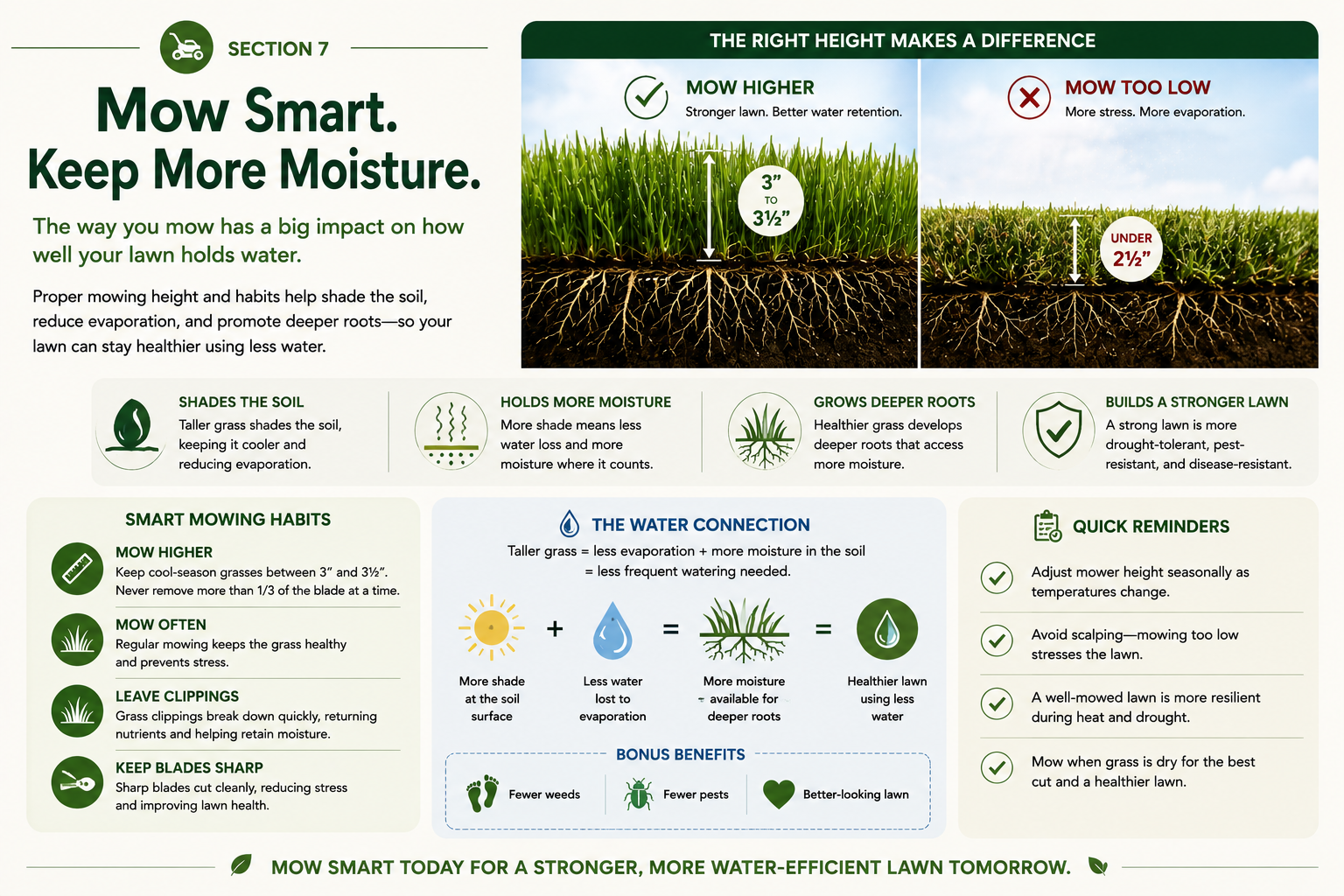
STEP FOUR
Don't Mow Your Lawn Too Short
That golf-course look isn't necessarily helping a Colorado lawn survive drought.
Keeping cool-season grasses such as Kentucky bluegrass somewhat taller can help shade the soil and improve water efficiency.
A good target during the growing season is generally around:
2.5–3.5 inches
Avoid removing too much of the grass blade at one time.
A healthy canopy can help protect the soil surface from intense Colorado sunshine while supporting the grass's root system.
Help Your Soil Work Smarter, Not Harder
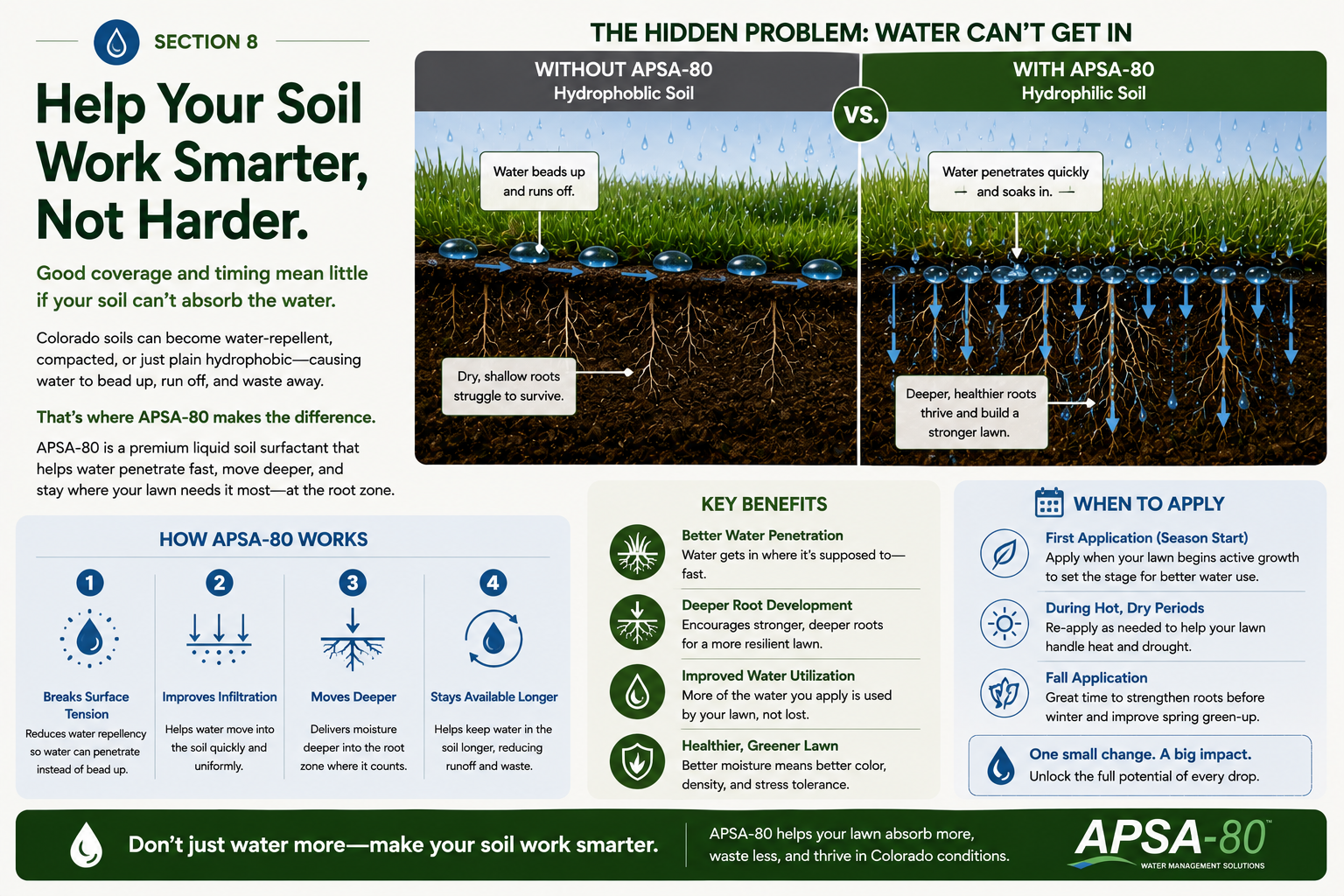
STEP FIVE
Help Water Get Into the Soil
Sometimes the problem isn't how much water is being applied.
It's how effectively that water moves into the soil.
This is where turf wetting agents can help.
Wetting agents are products designed to alter the way water interacts with soil.
They can temporarily help water spread and move into areas where infiltration is difficult.
That can be particularly useful when your goal is:
Improving water distribution
Reducing localized dry areas
Helping irrigation penetrate rather than bead or run off
Making limited watering opportunities more productive
Colorado State University Extension specifically recognizes turf wetting agents as one tool that can temporarily assist water infiltration.
But there's an important distinction.
WETTING AGENT VS. AERATION
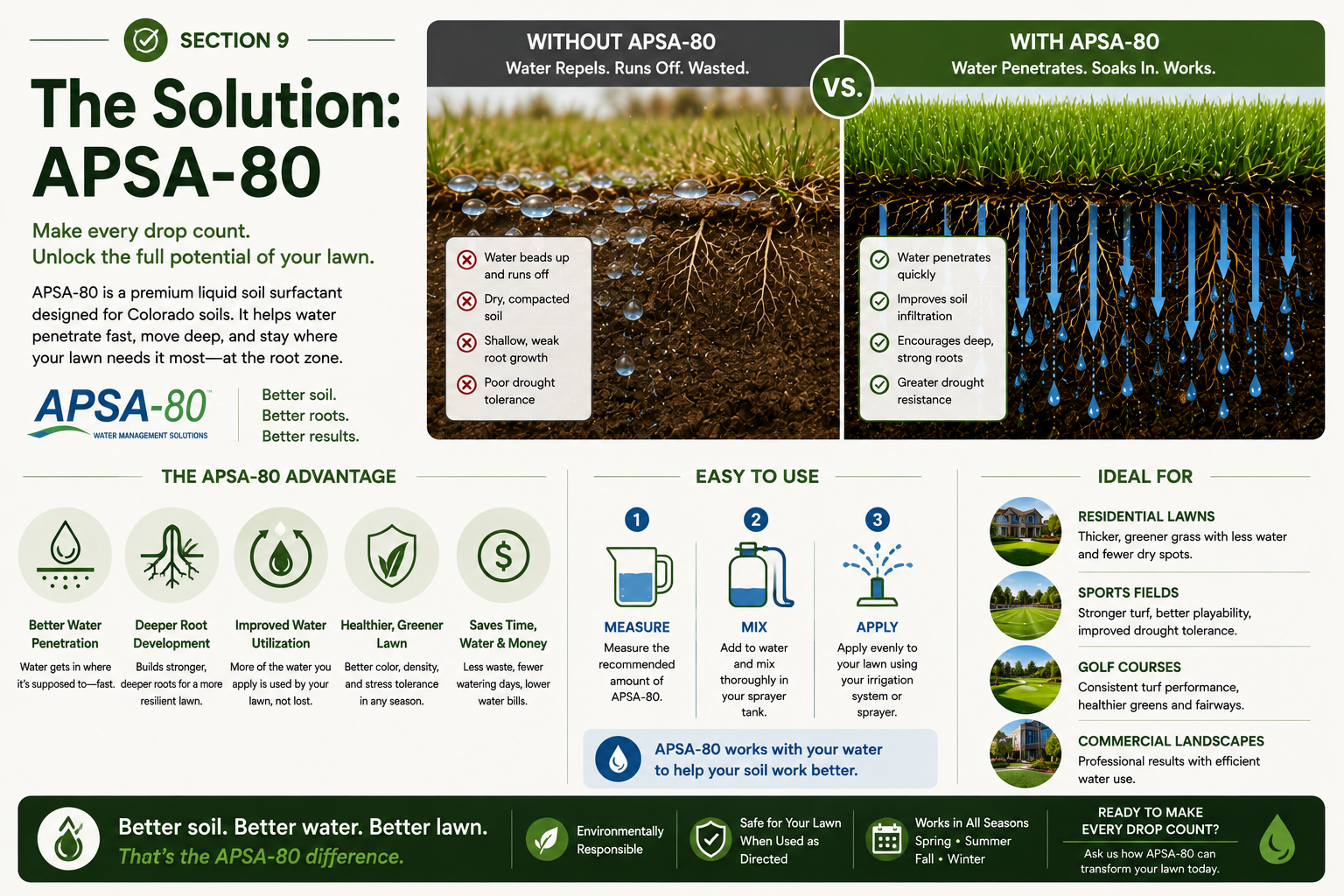
A Wetting Agent Is Not the Same Thing as Core Aeration
You've probably seen treatments advertised as “liquid aeration.”
We prefer to be more precise.
A turf wetting-agent treatment can help water move through the soil more effectively.
It does not mechanically remove soil cores.
If your lawn has significant physical soil compaction or excessive thatch, traditional core aeration may still be the appropriate tool.
Think of them as addressing different problems:
CORE AERATION
Helps physically relieve compaction and excessive thatch by removing plugs of soil.
WETTING-AGENT TREATMENT
Helps improve the way water spreads and temporarily infiltrates the soil.
Sometimes one is appropriate.
Sometimes the other is appropriate.
And sometimes they complement each other.
The goal should be solving the lawn's actual problem—not simply selling a treatment.
Read:
Liquid Aeration vs. Core Aeration in Colorado: What Actually Works?
Make Every Drop Work Harder
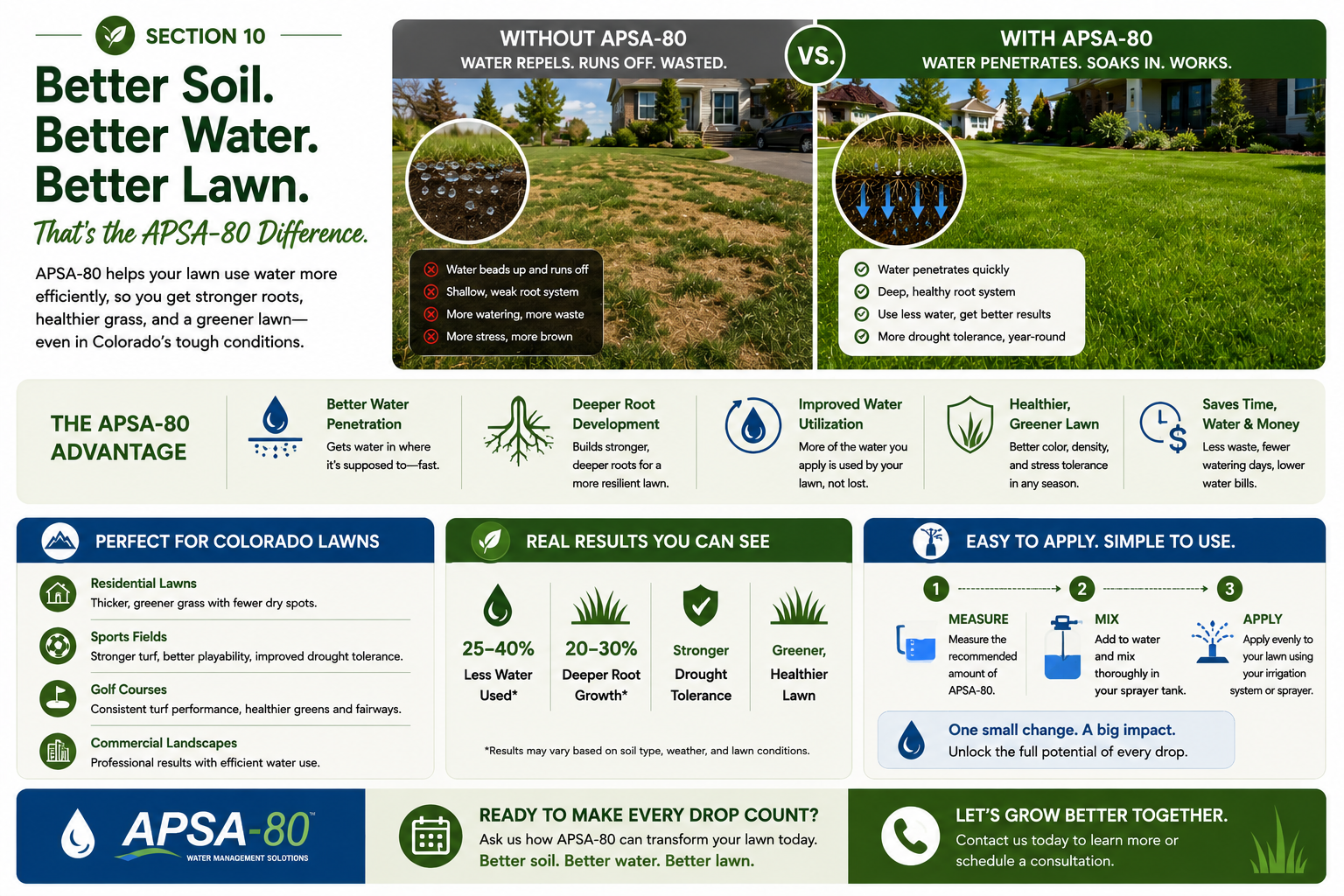
When you're limited to two watering days, getting water into the soil matters more than ever.
Western Synergy offers a professional residential turf wetting-agent treatment designed to support more effective water movement into the soil.
Standard Residential Yard — $40
Discounted Rates for 3+ Yards in a Neighborhood
No plugs.
No soil cores scattered across the lawn.
No major equipment running across your property.
Just a straightforward treatment focused on helping the water you're already applying work more effectively.
Call or Text Kevin
720-277-9110
Larger properties may require additional treatment. Watering restrictions vary by provider; customers remain responsible for following all applicable watering rules.
A SIMPLE TWO-DAY WATERING STRATEGY
Before Your Next Watering Day
1. Inspect
Check sprinkler heads for damage, poor coverage, leaks, and overspray.
2. Measure
Use several shallow containers to see whether your lawn is receiving water evenly.
3. Cycle
Break longer sprinkler runtimes into shorter cycle-and-soak periods when runoff is occurring.
4. Watch
Stop watering if water begins flowing into sidewalks, driveways, streets, or gutters.
5. Check
Use a screwdriver, soil probe, or small shovel after watering to see how deeply moisture actually penetrated.
6. Adjust
Don't automatically add minutes to the entire irrigation system because one area looks dry.
7. Improve
If water penetration appears to be part of the problem, consider whether aeration, irrigation repairs, or a turf wetting agent may help.
Brown Doesn't Always Mean Dead
During severe heat and drought, cool-season turf can show stress.
That does not necessarily mean the lawn needs endless additional irrigation.
A lawn can lose some of its bright green appearance while the important growing portions of the grass remain alive.
When conditions improve, healthy turf may recover.
The objective during an extreme drought shouldn't necessarily be:
“How do I make my lawn look like April in the middle of August?”
A better question is:
“How do I keep my landscape healthy while using water responsibly?”
That's a better strategy for your lawn, your water bill, and Colorado's water supply.
FAQ
Frequently Asked Questions About Lakewood Lawn Watering During Drought
Is watering twice a week enough for a Colorado lawn?
It can be. Efficient watering matters enormously. Soil type, grass species, shade, irrigation coverage, rooting depth, weather, slope, and overall lawn health all influence how much water a lawn needs.
The objective is to wet the active root zone without creating unnecessary runoff or watering beyond the depth of the roots.
Can I water my lawn every day if I use less water each time?
Not if your water provider limits lawn irrigation to assigned watering days.
Denver Water customers are currently restricted to two assigned lawn-watering days per week through September 30, 2026.
Always check the requirements of your specific Lakewood-area water provider.
Can I water between 10 a.m. and 6 p.m.?
Denver Water currently prohibits lawn watering between 10 a.m. and 6 p.m.
Other Lakewood-area providers may have similar or additional restrictions.
What happens after September 30, 2026?
Denver Water has announced that grass watering and spray irrigation will be prohibited beginning October 1, 2026, except where specific approved exceptions apply.
Hand watering or qualifying low-volume irrigation for trees, shrubs, gardens, and other plants may be treated differently under the rules.
Check your own water provider before watering.
What is a lawn wetting agent?
A turf wetting agent changes how water interacts with the soil, helping it spread and temporarily move into difficult-to-wet areas more effectively.
It is a water-management tool—not a replacement for water.
Is a wetting agent the same as liquid aeration?
The terms are sometimes used interchangeably in lawn-care marketing, but they shouldn't be.
A wetting agent can help water movement.
Traditional core aeration physically removes small plugs of soil and can relieve compaction and reduce thatch.
They solve different problems.
Will a wetting-agent treatment fix severely compacted soil?
Not necessarily.
If physical compaction is the primary problem, core aeration may be more appropriate.
A good lawn strategy begins by identifying why water isn't reaching the root zone effectively.
Should I simply water longer if my lawn has dry spots?
Not automatically.
First determine whether the dry area is receiving less water because of sprinkler coverage.
Increasing the runtime of the entire zone to solve one dry spot may simply overwater the rest of your lawn.
Does Western Synergy serve areas outside Lakewood?
Western Synergy serves Lakewood and surrounding Denver-area communities.
Contact us with your location and yard size to confirm availability.
Colorado Is Asking Us to Use Less Water.
Let's Make the Water We Do Use Count.

Better irrigation practices.
Less unnecessary runoff.
Smarter water management.
And when appropriate, a professional turf wetting-agent treatment to help water move more effectively into the soil.
Standard Residential Yard Treatment — $40
Call or Text Kevin
720-277-9110