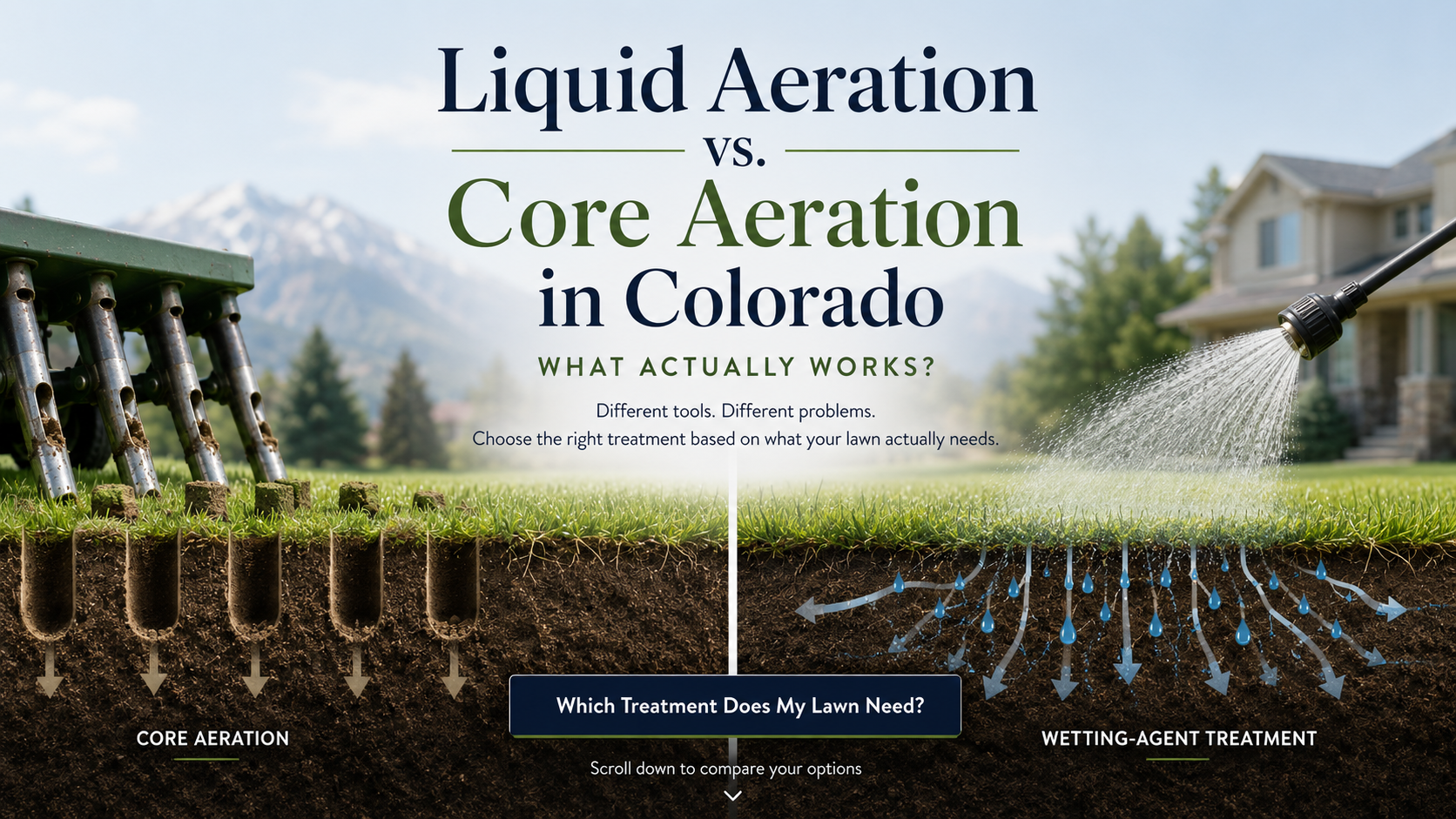
Liquid Aeration vs. Core Aeration in Colorado: What Actually Works?
If your Colorado lawn struggles with hard soil, runoff, dry spots, or poor water penetration, you've probably heard two very different recommendations:
“Core aerate it.”
and
“Try liquid aeration.”
They aren't the same thing.
And depending on what's actually happening in your lawn, one may make considerably more sense than the other.
Understand the problem before choosing the treatment.
WHY THIS GETS CONFUSING
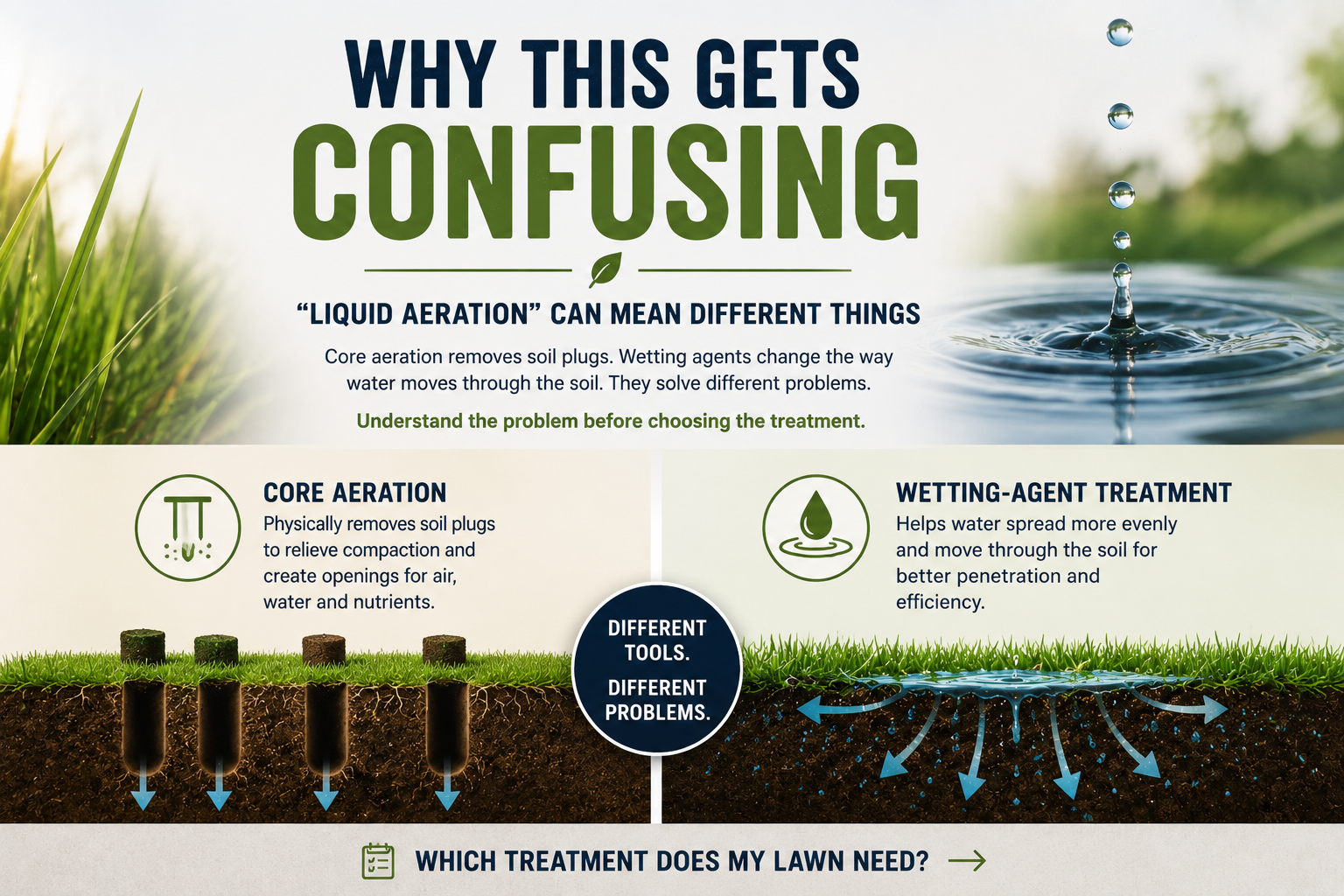
“Liquid Aeration” Can Mean Different Things
Traditional core aeration is easy to understand.
A machine physically pulls plugs of soil from the lawn.
“Liquid aeration,” however, is primarily a marketing term rather than one standardized lawn-care process.
Different products sold under that description may contain different ingredients and claim to affect soil in different ways.
One category commonly associated with the conversation is turf wetting agents or soil surfactants.
These products influence how water interacts with soil.
But that distinction matters:
Improving water movement is not the same thing as physically relieving soil compaction.
That's why it's more useful to ask:
“What problem am I trying to solve?”
instead of simply:
“Which aeration should I buy?”
WHAT CORE AERATION ACTUALLY DOES
Core Aeration Physically Changes the Soil
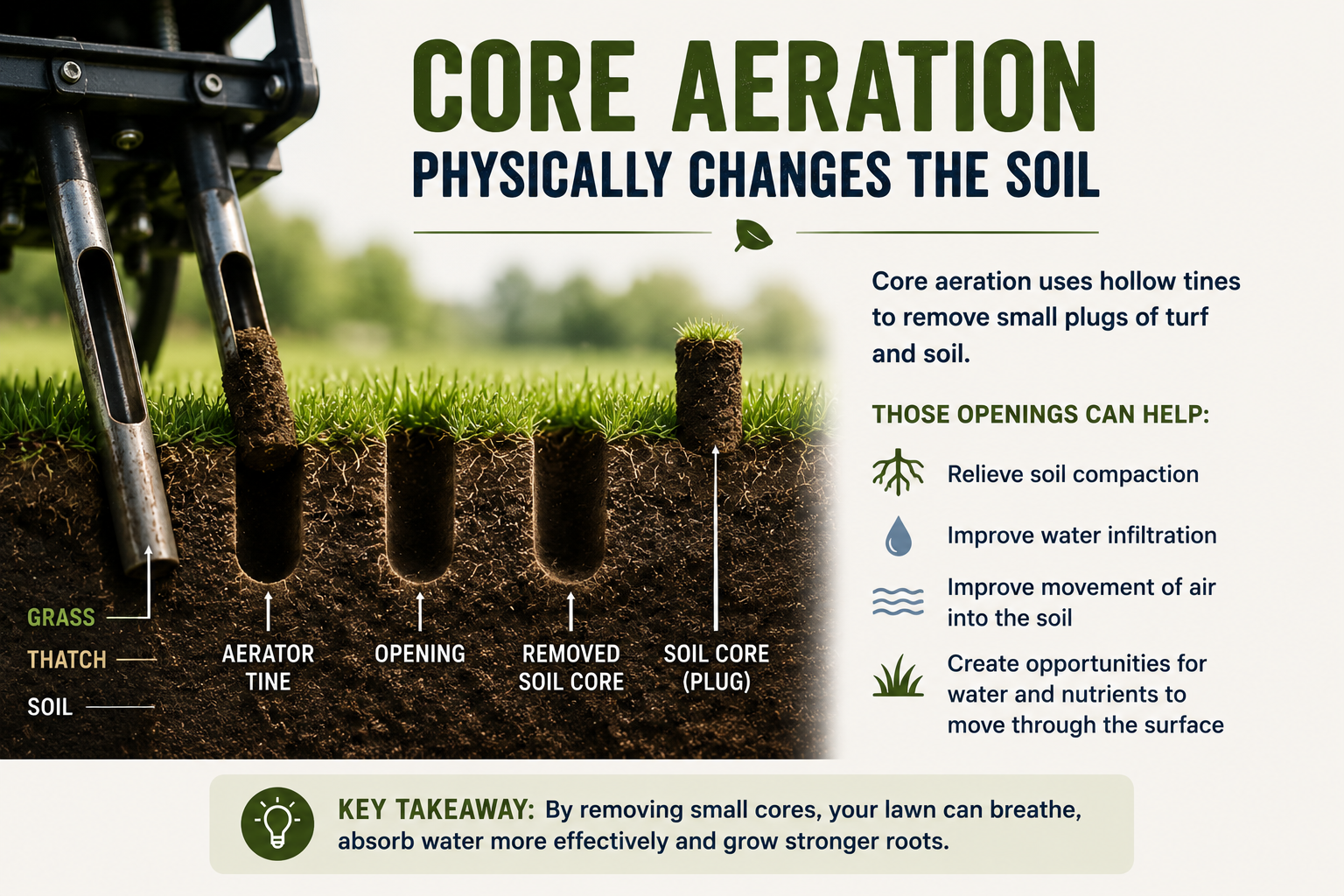
Traditional core aeration uses hollow tines to remove small plugs of turf and soil.
Those openings can help:
Relieve soil compaction
Reduce problems caused by excessive thatch
Improve water infiltration
Improve movement of air into the soil
Create opportunities for water and nutrients to move through the surface
Colorado State University Extension identifies core cultivation as a way to address infiltration problems associated with compaction and thatch.
What does it look like?
After core aeration, you'll typically see small soil plugs scattered across the lawn.
Those plugs can usually be left in place to break down naturally.
Core aeration is especially useful when:
The soil is physically compacted.
That can happen from:
Foot traffic
Pets
Children playing
Heavy equipment
Repeated mowing
Construction activity
Naturally dense soils
Key takeaway:
If compaction is the problem, physically relieving the compaction makes sense.
WHAT A WETTING AGENT ACTUALLY DOES
Wetting Agents Work on Water — Not by Removing Soil
A turf wetting agent works very differently.
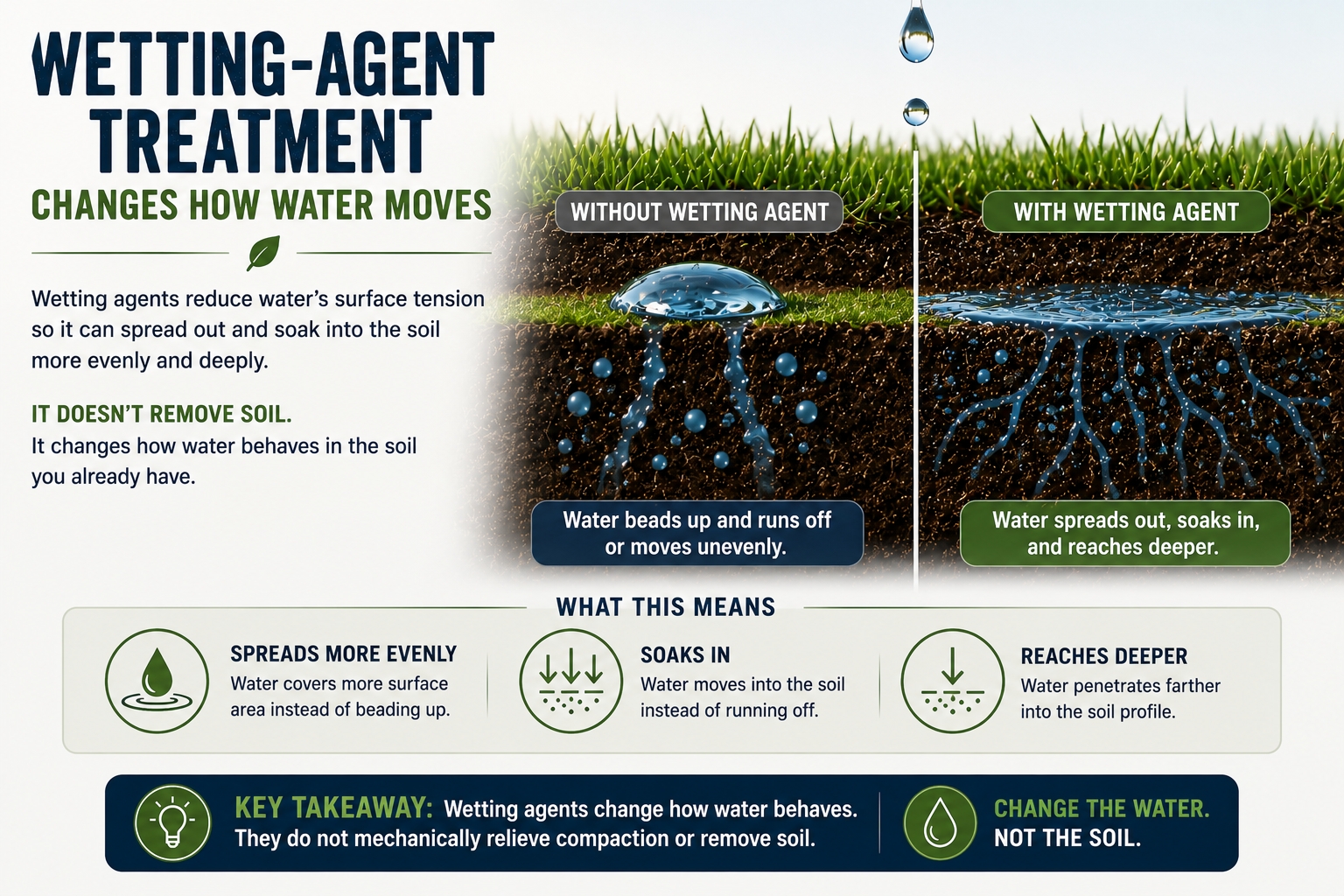
It affects the way water interacts with the soil.
Water molecules naturally have surface tension. Under some soil conditions, irrigation may spread poorly, move unevenly, or contribute to localized dry areas.
A turf wetting agent can temporarily help water spread and move into the soil more effectively.
CSU Extension specifically notes that wetting agents designed for turf can temporarily assist water infiltration.
A wetting agent may help with:
Uneven water movement
Localized dry areas
Water penetration
Irrigation efficiency
Water spreading through difficult-to-wet soil
But it does something very important not to claim:
It does not mechanically remove compacted soil.
And it doesn't make thatch disappear.
THE COLORADO CLAY-SOIL QUESTION
What About Colorado's Heavy Soils?
This is where homeowners can easily get oversold.
If you have dense, compacted soil, simply spraying something onto the lawn does not create the same physical openings that core aeration creates.
Colorado State University notes that core aeration can improve infiltration by reducing compaction and thatch, while wetting agents should not be treated as a cure-all when those are the underlying problems.
So if someone tells you:
“You never need to core aerate again because this liquid breaks up your compacted clay…”
be skeptical.
A better way to think about it is:
CORE AERATION
Changes the physical structure of the compacted turf/soil.
WETTING AGENT
Changes the way water behaves as it moves through the soil.
Those aren't competing definitions.
They're different functions.
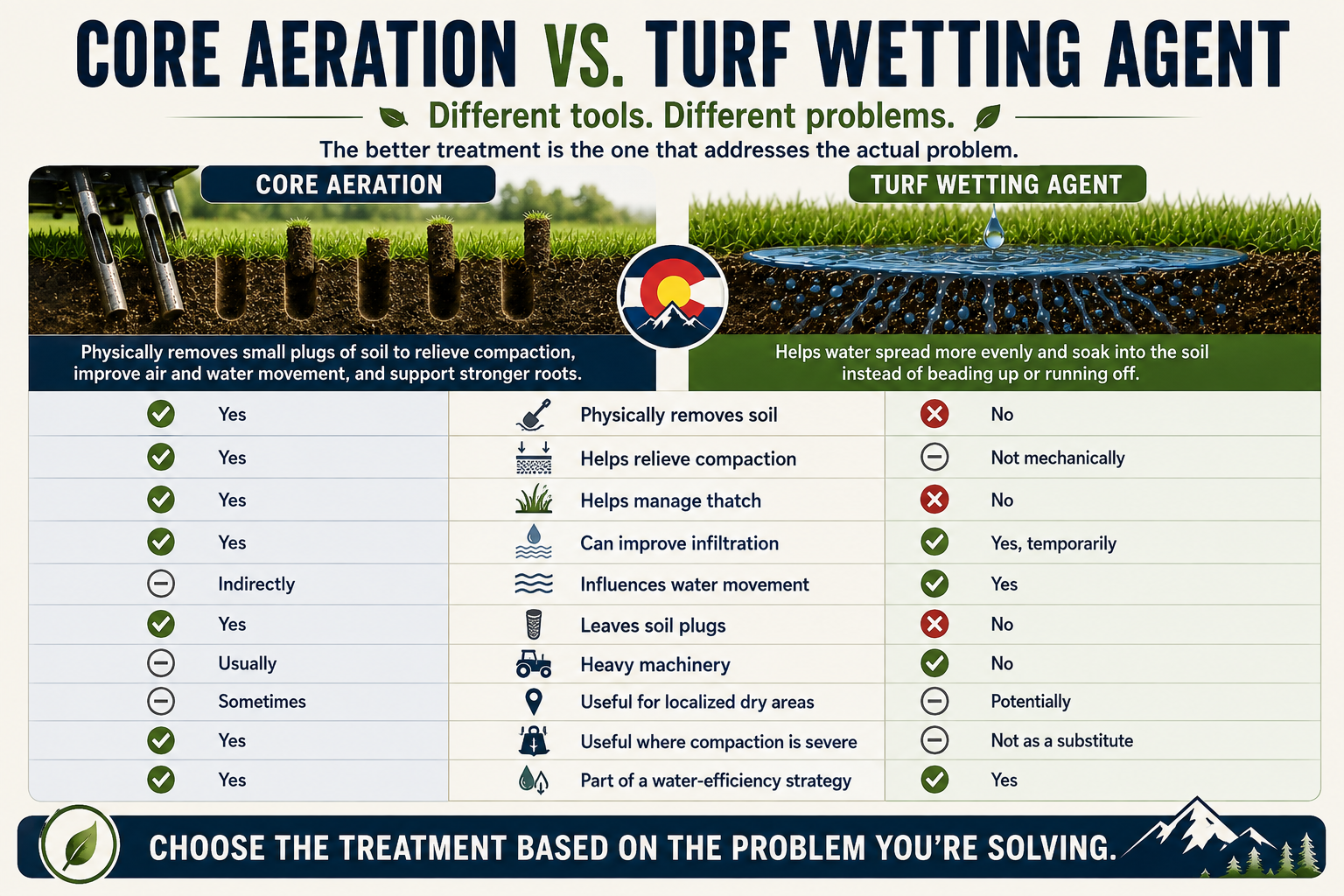
SIDE-BY-SIDE COMPARISON
Liquid/Wetting-Agent Treatment vs. Core Aeration
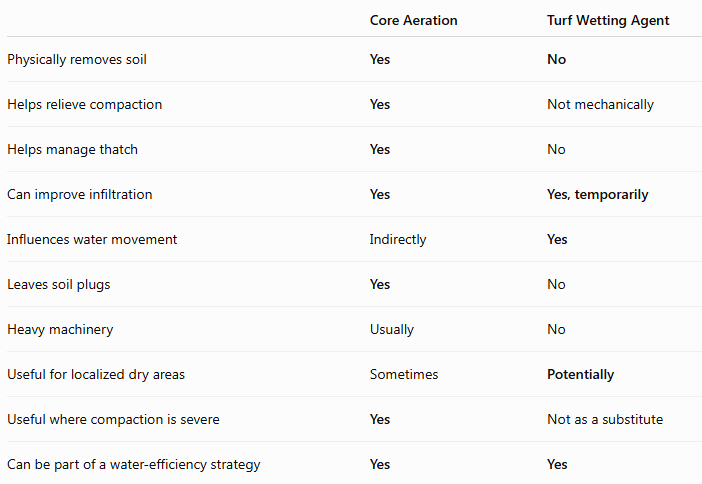
So which one is “better?”
Neither.
The better treatment is the one that addresses the actual problem.
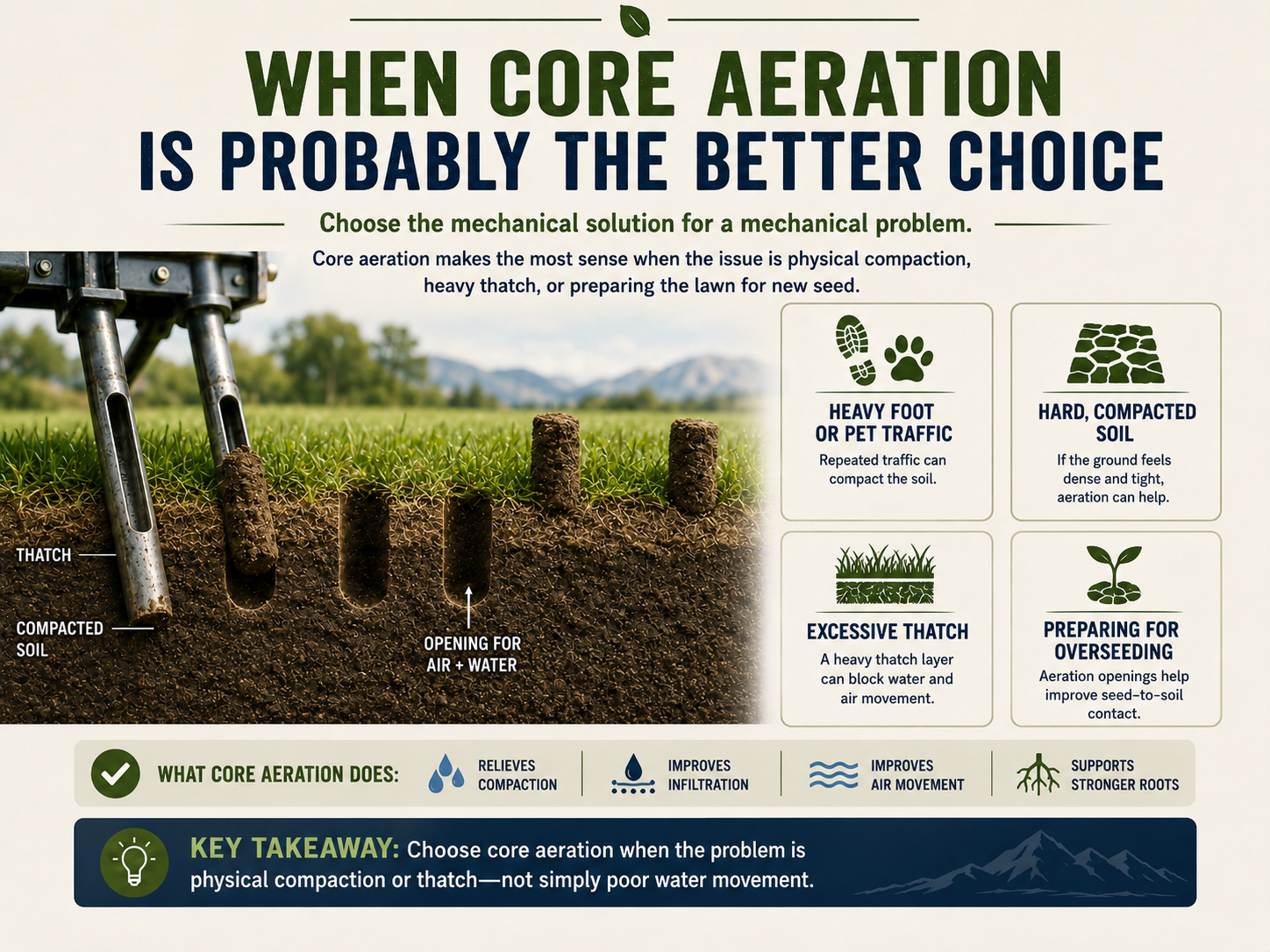
WHEN CORE AERATION IS PROBABLY THE BETTER CHOICE
Choose the Mechanical Solution for a Mechanical Problem
Core aeration deserves serious consideration if:
Your lawn sees heavy traffic
Dogs, children, entertaining areas and frequently traveled paths can compact soil.
The ground feels unusually hard
A soil probe or screwdriver can help you get a basic sense of resistance when soil has adequate moisture.
Water infiltration problems are associated with compaction
If the pore spaces in the soil have been physically compressed, removing cores can help relieve that condition.
You have excessive thatch
Core cultivation can help manage thatch as part of an appropriate lawn-care program.
You're overseeding
Aeration openings can also help create useful soil contact during renovation and overseeding.
CSU Extension specifically recommends core aeration as one tool for managing soil compaction.
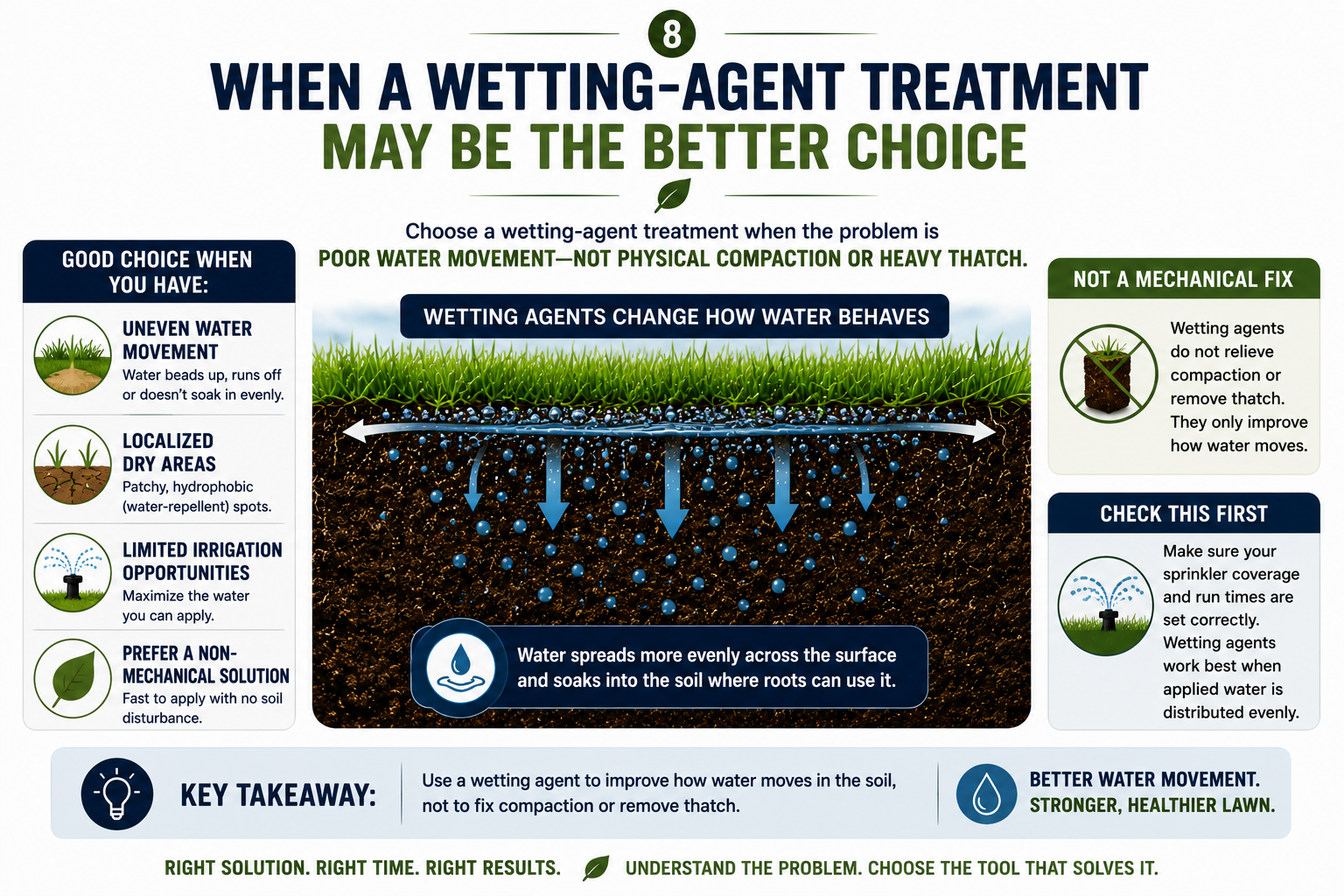
WHEN A WETTING AGENT MAY MAKE MORE SENSE
Sometimes Water Movement Is the Bigger Issue
A wetting-agent treatment may make sense when:
Water isn't spreading well through the soil
Some portions of the lawn may dry considerably faster than others.
You're seeing localized dry areas
Especially after checking that sprinkler coverage is actually adequate.
You're trying to get more benefit from limited irrigation
During Colorado drought conditions, improving how efficiently irrigation enters and moves through the soil can be valuable.
You don't necessarily have severe compaction
If water movement is the primary issue rather than physical soil structure, a wetting agent addresses a different part of the problem.
You want a non-mechanical treatment
There are no plugs scattered across the yard and no aerator traveling across the lawn.
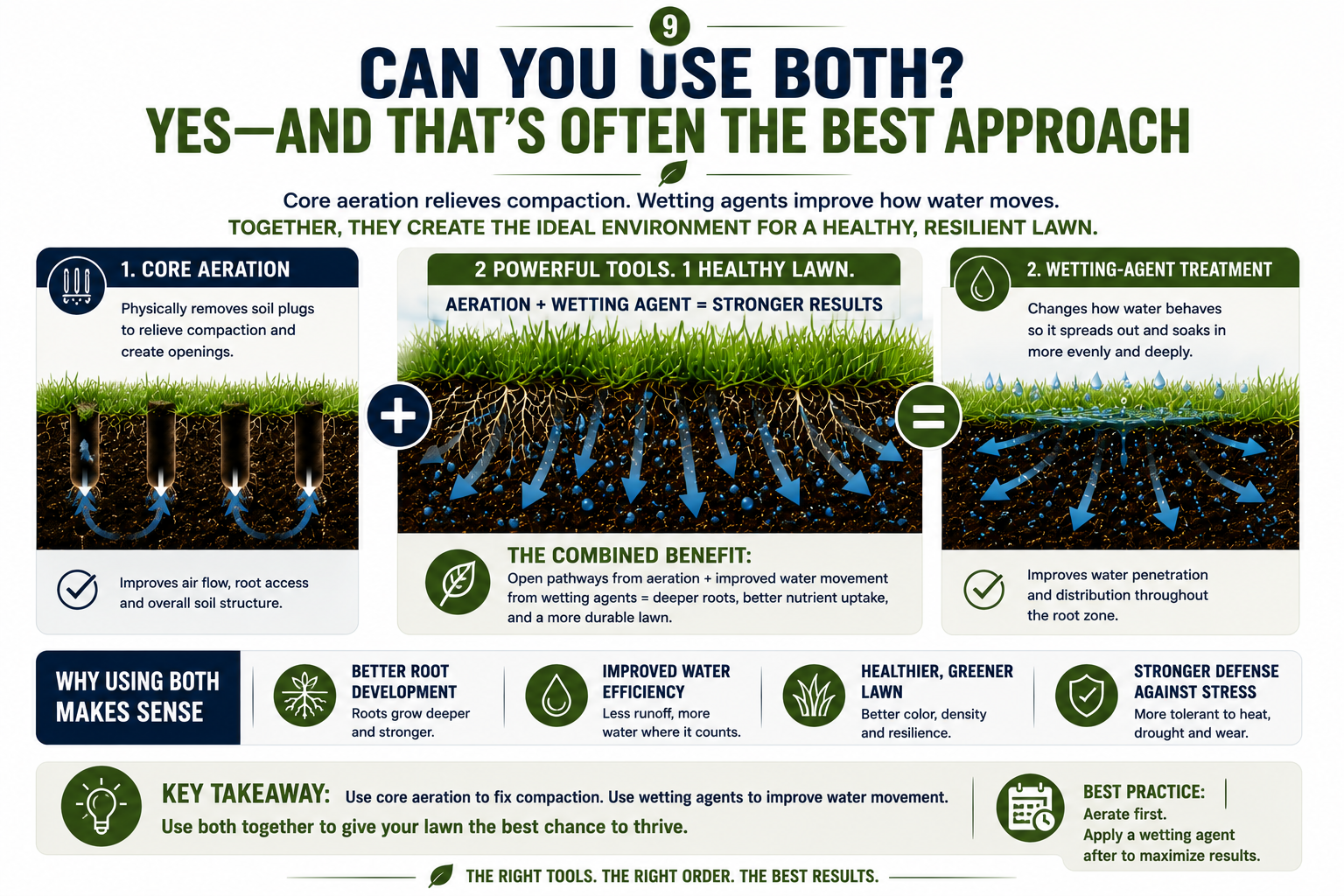
CAN YOU USE BOTH?
Absolutely — Because They're Doing Different Jobs
This may actually be the most important part of the page.
It doesn't have to be:
CORE OR LIQUID
In the right situation, it can be:
CORE AND WATER MANAGEMENT
Imagine a lawn with:
Compacted soil
Poor infiltration
Runoff
Limited watering opportunities
Core aeration could help address the physical compaction.
A properly selected wetting agent could help address water movement.
Better irrigation practices could help address application rate and runoff.
That's a lawn-management strategy.
Not a miracle product.
And that's the approach we prefer.
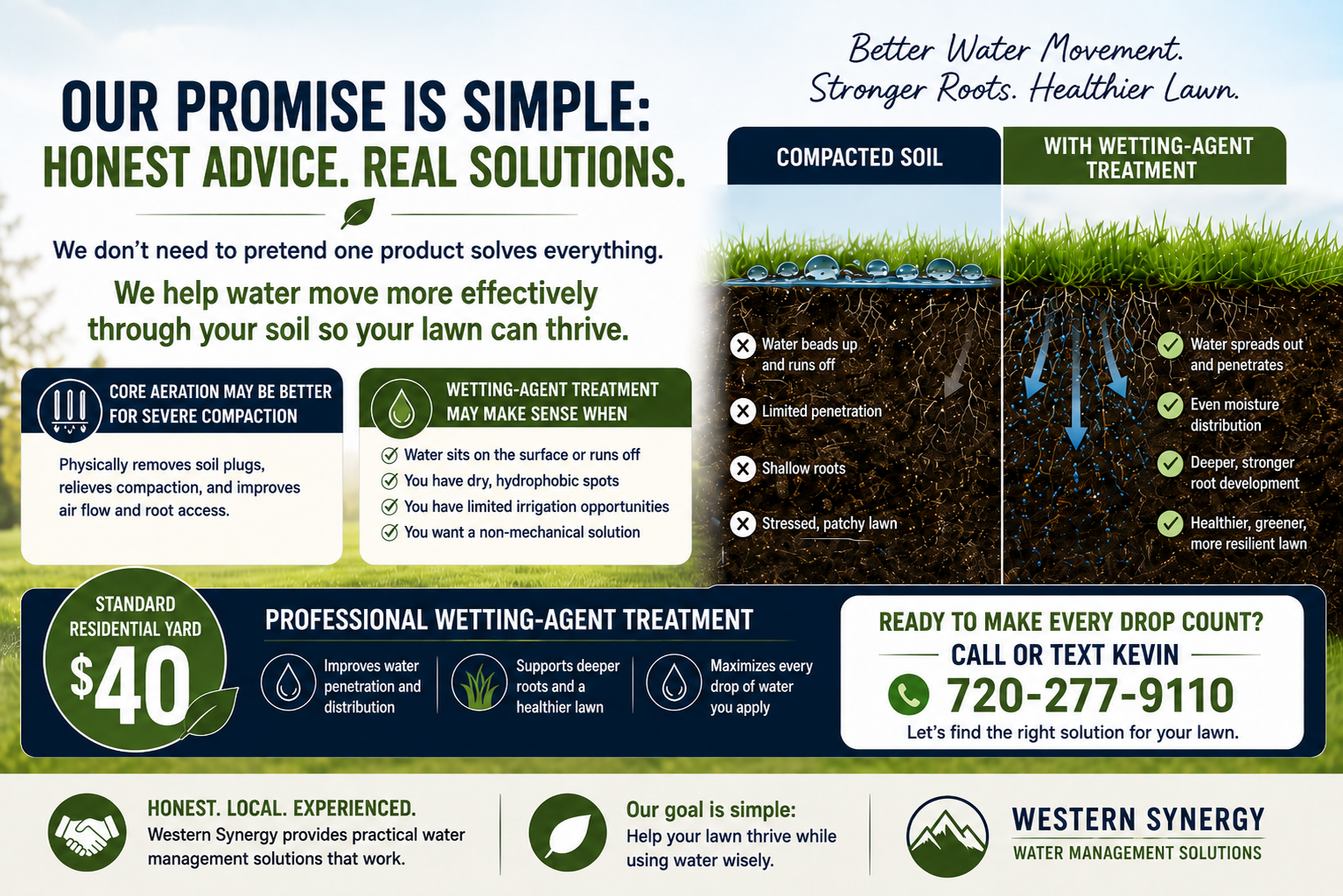
We Don't Need to Pretend One Product Solves Everything
Western Synergy's residential lawn treatment is focused specifically on:
Helping Water Move More Effectively Through the Soil
We use a professional turf soil-surfactant/wetting-agent approach as part of a broader water-efficiency strategy.
We do not claim that it physically replaces core aeration.
If your biggest issue appears to be severe soil compaction, core aeration may still be the better recommendation.
If the problem is water penetration, localized dry areas, or trying to make limited irrigation more productive, a wetting-agent treatment may be worth considering.
Standard Residential Yard Treatment — $40
Call or Text Kevin
720-277-9110

Which One Should I Choose?
Is your lawn heavily compacted?
YES → Consider core aeration
NO / NOT SURE → Keep going ↓
Is excessive thatch a significant problem?
YES → Consider core aeration
NO → Keep going ↓
Is water pooling, running off or penetrating unevenly?
YES → Check sprinkler coverage first.
Then consider:
Cycle-and-soak irrigation
and/or
A turf wetting-agent treatment
Do you have both compaction and water-movement problems?
Consider using both strategies as appropriate.
Not sure?
Start by diagnosing the problem rather than buying the treatment.
BUTTON:
Ask Kevin About My Lawn
Before You Change Your Lawn Treatment, Check Your Watering Strategy
Aeration is only one part of water-efficient lawn care.
Sprinkler coverage, watering timing, cycle-and-soak irrigation, mowing height and soil conditions all affect how efficiently your lawn uses water.
READ NEXT:
How to Keep a Lakewood Lawn Healthy With Only Two Watering Days a Week
Does liquid aeration really work?
It depends on what is actually being sold as “liquid aeration” and what problem you're trying to address.
A turf wetting agent can help water move through soil more effectively. That does not mean it physically aerates compacted soil in the same manner as a core aerator.
Is liquid aeration the same as core aeration?
No.
Core aeration physically removes plugs of soil.
A wetting-agent treatment affects how water spreads and moves through the soil.
They operate differently and should not be presented as identical treatments.
Can a wetting agent replace core aeration?
Not when significant soil compaction or thatch is the underlying problem.
CSU Extension specifically cautions that wetting agents should not be considered a cure-all for those conditions.
Will liquid aeration break up Colorado clay soil?
A wetting agent should not be described as mechanically breaking apart compacted clay in the same way that core aeration creates physical openings in the soil.
If compaction is the problem, investigate core aeration.
Can a wetting agent help a Colorado lawn use water more efficiently?
It may help temporarily improve water movement and infiltration in appropriate turf conditions.
It should be combined with good irrigation practices rather than used as an excuse to apply more water.
Should I core aerate every year?
That depends on your lawn, soil, traffic, thatch and compaction.
Lawns with significant compaction may benefit from regular core aeration, while other lawns may need it less frequently.
Can I core aerate and use a wetting agent?
Yes.
Because they address different issues, there are situations where both can reasonably be part of the same lawn-care strategy.

Don't Choose a Treatment by Its Name.
Choose It by the Problem You're Trying to Solve.
Compacted soil?
Core aeration may be the right tool.
Poor water movement?
A turf wetting-agent treatment may help.
Both?
Your lawn may benefit from a combination of strategies.
Make Every Drop Work Harder.
Standard Residential Yard Treatment — $40
Call or Text Kevin
720-277-9110